

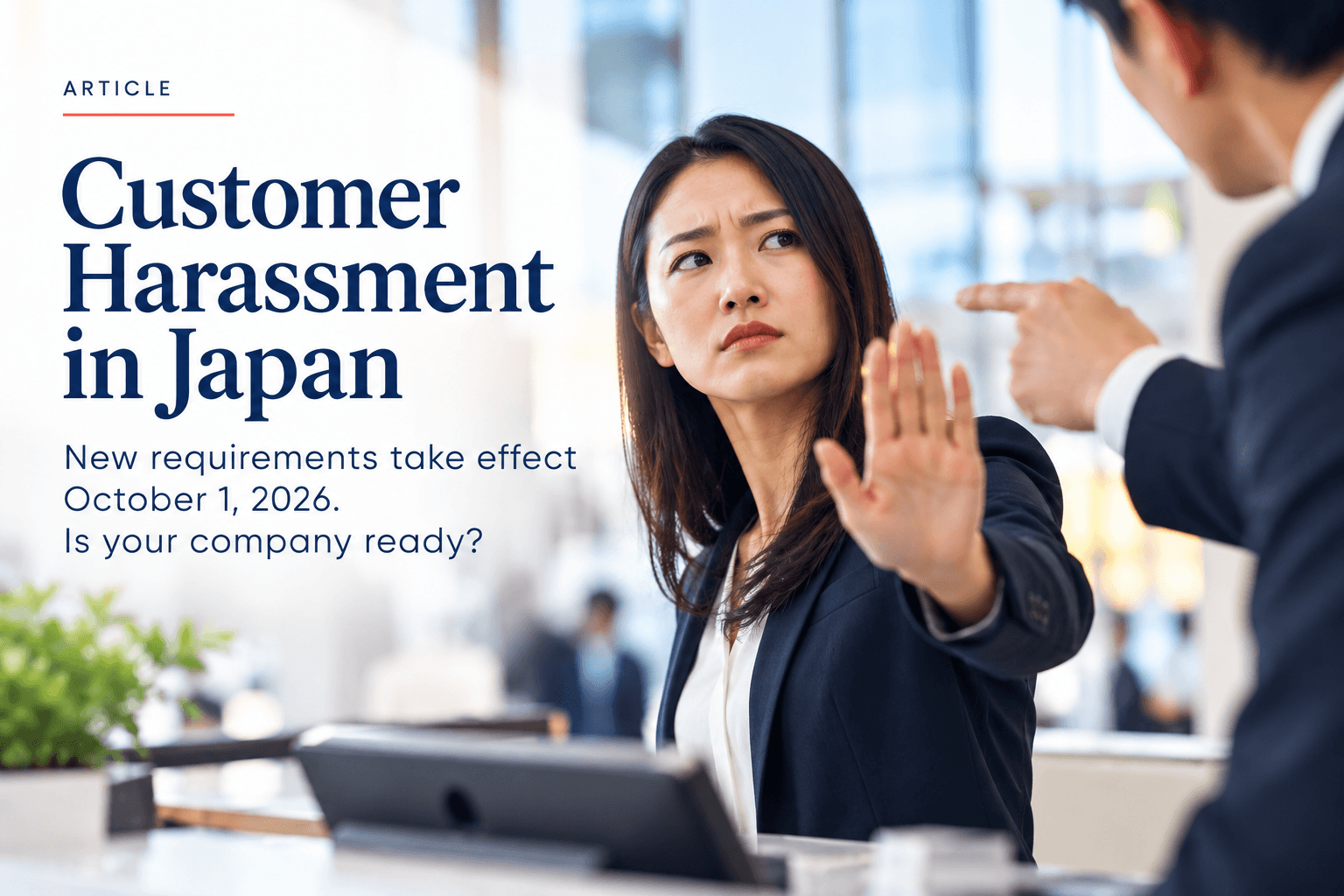
October 1 Is Coming: Is Your Company Ready for Japan’s New Customer Harassment Requirements?
October 1, 2026 marks an important change in Japan’s workplace harassment rules. From that date, employers will be legally required to take measures to prevent customer harassment (kasutoma harasumento or kasuhara in Japanese).
For companies with non-Japanese managers in Japan, this is a good time not only to prepare for the new customer harassment requirements, but also to review whether all of your managers understand the full range of harassment issues covered by Japanese law.
What Is “Customer Harassment”?
“Customer harassment” is a term that may be unfamiliar to managers coming from outside Japan. It refers to situations in which the behavior of customers, clients, business partners, facility users, or others connected with a company’s business goes beyond what is socially acceptable and harms an employee’s working environment.
Importantly, this does not mean that every difficult customer or strongly expressed complaint constitutes harassment. Customers have a legitimate right to complain about products and services. The distinction lies in factors such as the nature of the behavior, the reasonableness of the customer’s demands, the manner in which they are made, and their impact on the employee.
Customer harassment can take many forms. Obvious examples include threats, intimidation and abusive language, but the problem can be more subtle. A client might repeatedly contact an employee late at night, demand excessive amounts of the employee’s time, attack an individual employee’s competence in emails copied to senior management, insist on dealing only with a particular employee, or pursue an employee through personal social media accounts.
These situations can be particularly difficult for employees to manage on their own when the person involved is an important client or customer.
Why Is Customer Harassment Such an Issue in Japan?
Japan’s strong customer-service culture is one reason the issue has attracted particular attention.
Japanese employees have traditionally been expected to provide extremely attentive service and to avoid confrontation with customers. The well-known expression okyakusama wa kamisama desu — literally, “the customer is god” — reflects an attitude toward customer service that, taken too far, can make employees feel that they must tolerate inappropriate behavior.
Employees may also hesitate to tell a customer “no,” terminate an interaction, or escalate a situation to a manager. In some organizations, employees may worry that doing so will be viewed as an inability to handle the customer properly.
The new requirements make clear that companies cannot leave individual employees to manage these situations alone.
What Changes on October 1?
From October 1, employers throughout Japan will be required to take measures to prevent customer harassment.
Among other things, employers will need to establish and communicate a clear policy that the organization will respond firmly to customer harassment and protect its employees. Employees must be informed about what constitutes customer harassment and what they should do when it occurs.
Companies must also establish an appropriate consultation and reporting system and be prepared to respond promptly when incidents occur.
In practical terms, employees and managers need to know questions such as:
- When does a legitimate customer complaint cross the line into harassment?
- When should an employee stop handling a situation alone and involve a manager?
- What should a manager do when an important client is behaving inappropriately toward an employee?
- When is it appropriate to refuse further contact or service?
- How should incidents be documented and reported?
- How should an employee who has experienced customer harassment be supported?
A policy sitting on an intranet is not sufficient if the people expected to apply it do not understand what it means in practice.
Tokyo Companies Have Already Had a Head Start
For companies operating in Tokyo, customer harassment is not entirely new territory. The Tokyo Metropolitan Government’s Customer Harassment Prevention Ordinance has been in effect since April 1, 2025.
The ordinance prohibits customer harassment and calls on businesses to take measures to prevent it. Tokyo has also issued detailed guidelines to help companies develop their approach.
The new national requirement, however, makes October 1 an important milestone for employers throughout Japan.
An Opportunity to Check Your Overall Harassment Compliance
The October 1 change is also a useful reminder that customer harassment is only one part of Japan’s increasingly comprehensive harassment framework.
Companies operating in Japan are already required to take measures concerning sexual harassment, power harassment, and harassment related to pregnancy, childbirth, childcare and caregiving.
October 1 brings another important change as well: employers will be required to take measures to prevent sexual harassment of job seekers and other people engaged in recruitment activities.
This makes now an excellent time for HR and compliance teams to ask a broader question:
Do all of our managers — including our non-Japanese managers — understand Japan’s harassment requirements?
This can be an overlooked compliance gap in global organizations.
Managers transferred to Japan may have received extensive harassment training in their home countries. But Japan defines and categorizes harassment differently. “Power harassment,” for example, is a specifically Japanese framework that may be unfamiliar to someone who has managed teams elsewhere. Customer harassment is another concept that many overseas managers will never have encountered in compliance training received outside of Japan.
Cultural context matters as well. Japanese communication patterns, hierarchy, expectations regarding managers, traditional gender norms, and approaches to customer service can all affect how harassment situations develop and how employees respond to them.
Training Non-Japanese Managers
Japan Intercultural Consulting’s Preventing Harassment Problems in Japan e-learning course in English was developed specifically for non-Japanese managers working in Japan.
The 90-minute program covers:
- Sexual harassment, including the new protections for job seekers
- Maternity and paternity harassment
- Power harassment
- Customer harassment
- The Japanese cultural factors that can contribute to harassment problems
- How managers should respond when an employee reports a concern
Realistic examples and case studies help managers understand not simply what the rules say, but how harassment issues can actually arise in a Japanese workplace.
With the October 1 requirements approaching, this is an ideal time to review whether your organization’s harassment prevention education covers all of the areas required in Japan — and whether your non-Japanese managers have the knowledge they need to fulfill their responsibilities.
The course can be purchased online for individual participants. Corporate group enrollment is also available, and the program can also be delivered live and customized for your organization. We also offer harassment prevention training in Japanese. Contact us for further details.